Press conference in Q4 of 2026: the launch of the MOVE website and the publication of our commissioned research. Media only. Event details
What we stand for
We want vaping regulated, not banned. Keeping vaping products away from young people is non-negotiable. Adults who vape should have tested products, honest labelling and ingredients that can be traced.
Position one
We respectfully believe that a ban will not work. Strict and enforceable regulation can protect consumers better. It can also support legitimate businesses and maintain public revenue.
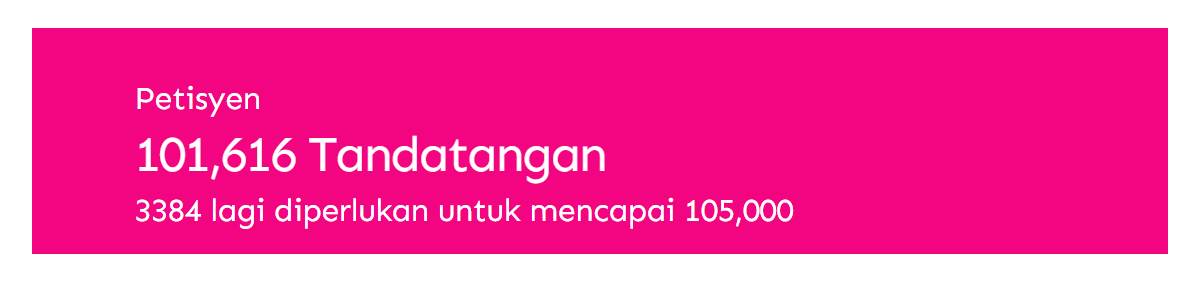
The petition page as captured by the Internet Archive on 11 November 2025, showing 101,616 signatures. The original page has since been taken down. Archived copy.
A ban removes the ability to control what is in the product. It does not remove the product. Kelantan’s local authorities have issued no licence for vape sale since 2013 and Johor’s since 1 January 2016, yet a decade on, both states are still seizing stock.
Singapore prohibits vape outright and has strict enforcement. Authorities still caught more than 2,400 people for possession and use in the second quarter of 2026.
In Australia, since the move to pharmacy-only sales in 2024, the government’s own commissioner estimates that 95.7% of vapes sold are illegal. Announcing a crackdown on the illicit tobacco and vape trade, its Assistant Minister for Customs said illicit tobacco had become a serious and organised crime crisis.
As an independent organisation with no profit motive, we are able to engage with government agencies, including at the ministry level, on developments in regulation on vaping in Malaysia.
In 2022 we submitted a memorandum of objection against the Generational End Game Bill at Parliament. We campaigned for the petition to keep vaping regulated, not banned, which reached 101,616 signatures as at 11 November 2025. We sought to present it, with a memorandum, to the Deputy Prime Minister’s office; the handover did not take place.
We have also commissioned an independent study, Malaysia’s Vape Ban: At the crossroads of public health and the black market, covering public health, product regulation and the illicit market.
Regulation over prohibition: more background
Kelantan’s exco member for local government said in June 2025 that no licence for vape sale had been issued at any premises since 2013 (Bernama, 18 June 2025). Enforcement operations continue, and seizures were made in both 2024 and 2025 (Bernama, 18 June 2025). Kelantan’s state local government committee chairman, Hilmi Abdullah, said in October 2026 that 42,759 vape units were seized across the state in 2025 (Kosmo, 15 October 2026).
Johor’s exco confirmed local authorities have issued no licence for vape sale since 1 January 2016 (Bernama, 24 November 2024). In Johor Baru alone, enforcement action was taken at 47 premises in 2024, seizing 14,866 vape devices (The Star, 30 March 2026).
Singapore’s Ministry of Health reported 2,428 people caught for possession and use in the second quarter of 2026, an average of 809 a month, about 30% below the 1,219 a month recorded from June to August 2025, before the tougher penalties commenced on 1 September 2025 (Singapore Ministry of Health, 11 August 2026).
Australia’s Illicit Tobacco and E-cigarette Commissioner estimated that 95.7% of e-cigarettes sold in Australia are illegal (ITEC Commissioner Report 2024-25, December 2025), and Assistant Customs Minister Julian Hill, announcing a crackdown on the illicit tobacco and vape trade, said illicit tobacco had become a serious and organised crime crisis (ABC News, 19 March 2026).
MOVE has set out this position publicly in The Vibes, 4 June 2025 and The Rakyat Post, 5 June 2025.
The petition figure of 101,616 is as recorded in the Internet Archive’s capture of 11 November 2025 (archived copy); the original petition page has since been taken down.
Position two
Youth access is a crisis. Protecting our youth is a non-negotiable priority. At the same time, adults should have the right to make informed choices.
We demand strict bans on online vape sales, comprehensive training for retail workers and rigorous age verification at every physical point of sale. If in doubt, verify: “Jika Sangsi, Minta IC”.
The problem starts with access. Vape products are sold in places young people pass every day, close to schools and next to everyday goods.
Where a product sits is only half of it. The other half is whether anyone checks. The people behind the counter need training, and age verification has to be a clear and consistent part of every sale, with access restricted to adults. Online, where nobody checks at all, the law’s prohibition on sale needs to be enforced.
The most recent national measurement of youth uptake is the Ministry of Health’s National Health and Morbidity Survey Adolescent Health Survey 2022, which put current e-cigarette use among those aged 13 to 17 at 14.9%, up from 9.8% in 2017.
We have argued since 2020 that age verification should be mandatory at every point of vape product sales. We have put that position to government agencies in our engagements.
We propose that no vape store should operate within 1 km of a school, that every vape store carries a clear sign that under-18s may not enter, and that every sale carries an identity check. Act 852 already bars sale within 40 metres of an educational institution.
If it is a specialist store, then there must be clear signage that under-18 youths are not allowed to enter or to purchase vape products.
If it is not a specialist store, retailers must also have clear signage that vapes cannot be purchased by under-18s, and at the same time outlet staff must be trained to carry out mandatory age checks.
On this site we publish plain-language guidance on what Act 852 requires of retailers, including the mandatory under-18 sales-prohibition sign at every point of sale.
The under-18 prohibition and the point-of-sale duties are in Act 852, in force since 1 October 2024: Attorney General’s Chambers register. The national figures on youth uptake come from the Ministry of Health’s Adolescent Health Survey 2022: Mohd Yusoff and colleagues, “Trends in e-cigarette use among adolescents in Malaysia, 2016-2022”, Tobacco Induced Diseases, 26 May 2026.
Position three
The danger comes from untested bottles. The Health Minister reported in June 2026 that 402 cases of vape laced with synthetic drugs, including THC (a substance illegal for recreational use in Malaysia), had been recorded up to April 2026, and the National Poison Centre logged 76 poisoning cases linked to such liquids between 2020 and 2024. Anyone buying a bottle should be able to see what is inside, and an adulterated bottle should lead back to whoever filled it.
Approved and unapproved liquids sit on the same shelf and look alike.
The law already provides a guidance for this. Before a product can be registered, the applicant must submit a laboratory analysis report from an approved laboratory, covering nicotine, humectants and flavouring agents by chemical compound, and emissions including formaldehyde, acetaldehyde and acrolein. Registration costs RM5,000 for each variant.
Under the Packaging and Labelling Regulations 2024, a compliant product then carries graphic and text health warnings across 65% of the front and the back, the manufacturer’s name and address, and nicotine capped at 20 mg per ml.
Consumers should be able to tell a compliant product from one that has not met the required safety and labelling standards.
We proposed a traceability code on every bottle to the Ministry of Health, so a buyer could scan it and see the ingredients and the maker. The proposal was well received; implementation has yet to take place.
Traceability can also strengthen enforcement. When every product can be linked to a registered manufacturer and its stated ingredients, regulators can see more of the supply chain and act faster when products do not meet the required standards. For consumers it is a simple way to check what they are buying.
We are still advocating for the code to be implemented, and in the meantime we raise awareness on what a compliant label looks like.
News of a sharp rise in vape-related poisoning cases involving suspected substances prohibited was reported by Berita RTM, 20 June 2026, and Bernama, 4 June 2025. Products marketed as ‘Magic Mushroom Vape’ were found by the National Poison Centre (PRN) to contain synthetic drugs capable of causing severe poisoning.
Testing requirement for vape products is regulation 2(2)(b) of the Registration Regulations 2024, P.U.(A) 262/2024, with the summary form prescribed by regulation 2(2)(c) and the Schedule. Labelling requirements are set by P.U.(A) 261/2024.
If you agree with all three, let us count you.
We write when the law moves.
Name and email only, used only for MOVE updates. Unsubscribe anytime.